
Our approach
A system for growth and innovation decisions.
A repeatable path from hard question to evidence, decision, and action.
We call it the Strategic Innovation Operating System. It has two parts. The Strategic Innovation Methodology structures the path from inquiry to decision to action. The Innovative Mindset creates the conditions your team needs to walk that path honestly. Together, they strengthen every decision and action that follows.

Strategic Innovation Methodology
A structured, flexible process for working through hard problems. We do not arrive with the answers. Nobody does, for questions like these. We arrive at them, with you, through a proven method that earns its confidence phase by phase and knows when to turn back.
It moves through four phases.
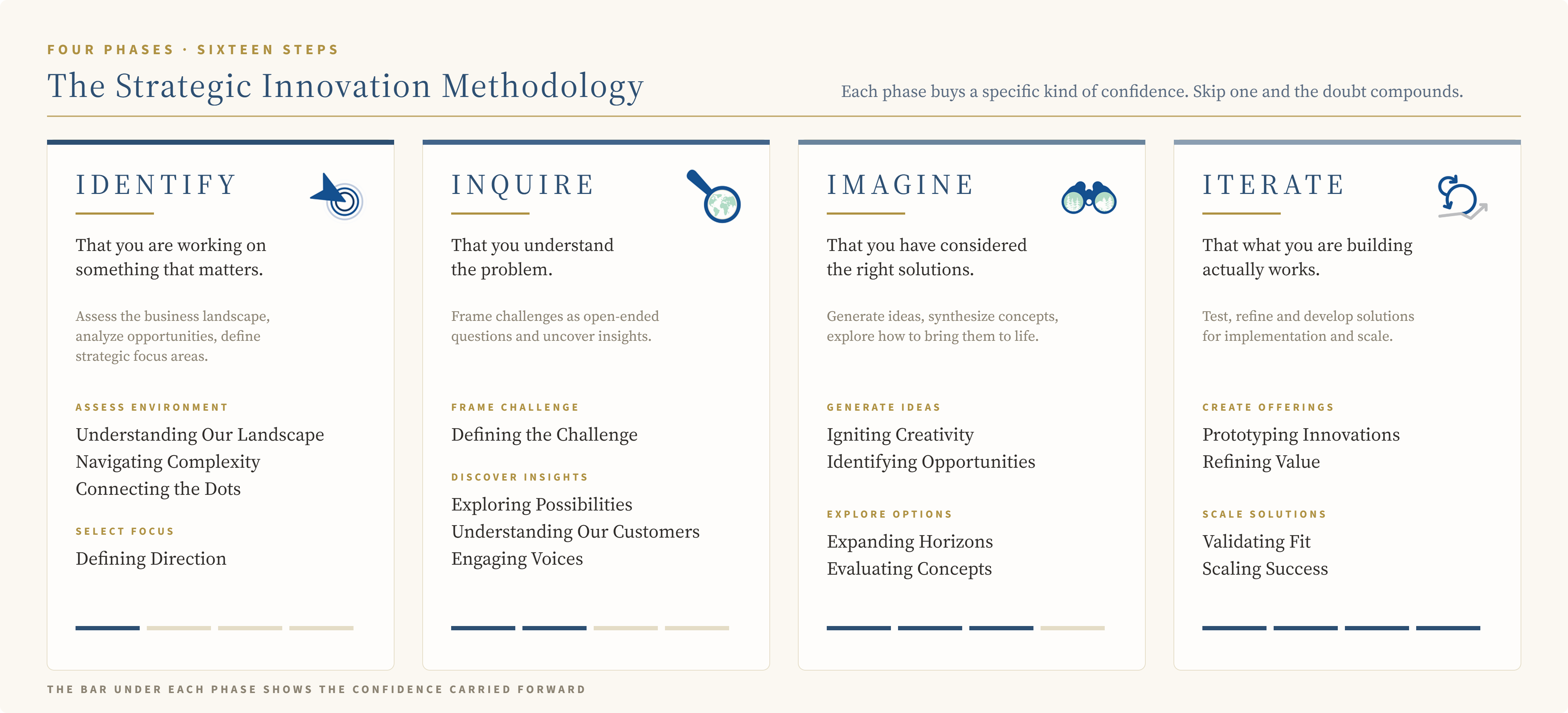

Identify
Read your situation and pick the focus that matters most, based on your strategy and the realities of your business.

Inquire
Take a real challenge, turn it into an open question, and dig for the insights hiding under the surface.

Imagine
Shape ideas into real options and look at what it would take to bring them to life.
Iterate
Sharpen the option leadership chooses into something specific and testable, sized to what your organization can actually do. Sometimes that is the first step, a baseline, a pilot, a prototype. It is never the last.
What makes the methodology different
Most of what is unusual about the methodology comes down to who does the work, and when.
Your team is in the work from the start
The people who will own the decision read the situation, meet the customers and study the market themselves. They do not work from someone else's summary of what is happening.
Research comes before ideas
Your team investigates customers, possible futures, technology and regulation first. Ideas come in the third phase, built on what your people found in the first two.
The same team stays through testing
The people who did the research test the strongest option and take it forward. The work does not pass to a different team partway through, so what your people learned early stays in the work.
Insight Lenses
The same problem looks different depending on where you stand. A question that seems settled from inside the organization is often wide open when you look at it from the customer's side, or from where the market is heading. Throughout the work we deliberately move between those positions rather than settling into one. We call these Insight Lenses. They are the reason our work finds the opening that a single point of view walks straight past.
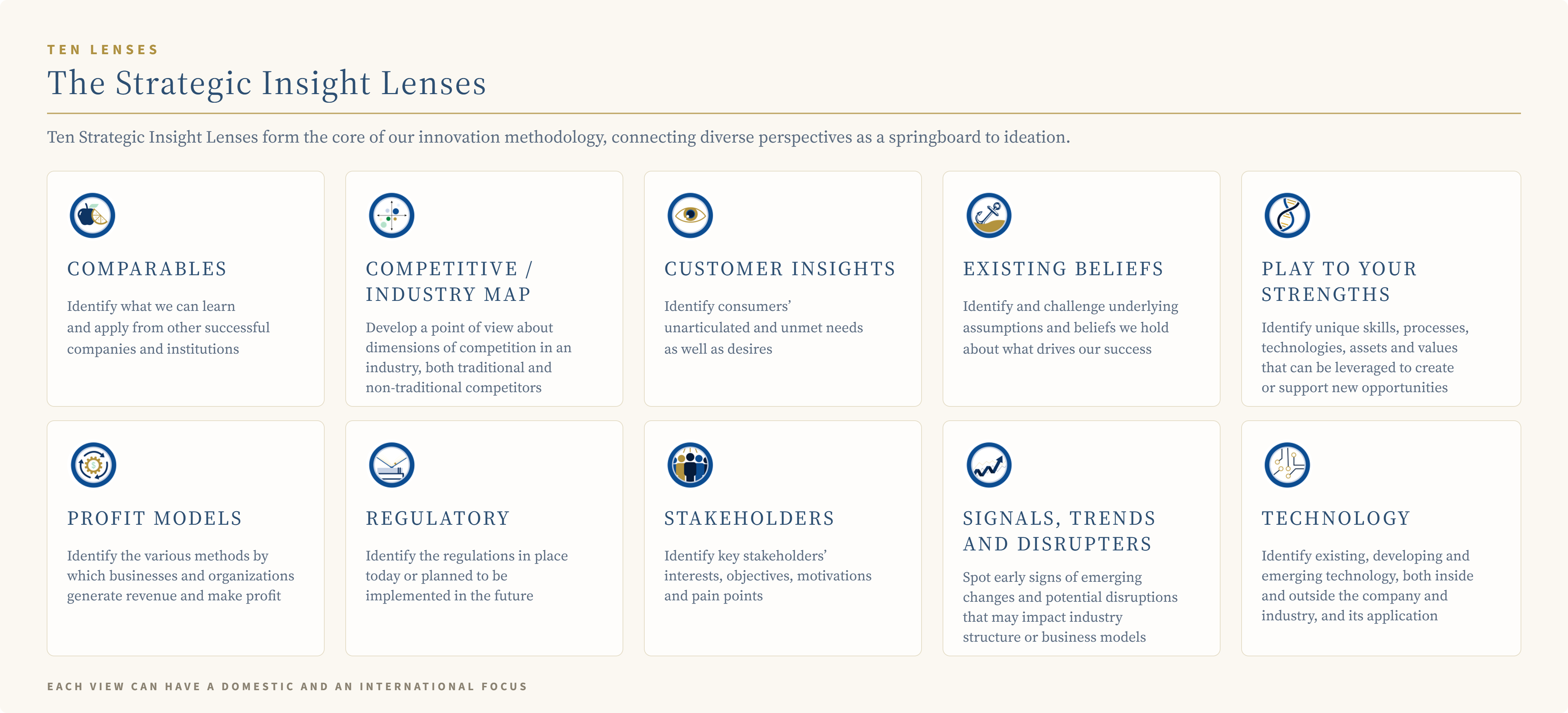
The ten lenses
Comparables
What we can learn from other companies and institutions that have already solved something like this.
Competitive and Industry Map
A clear point of view on how competition really works here, including the competitors nobody counts yet.
Customer Insights
What your customers need and want but have never put into words.
Existing Beliefs
The assumptions your company holds about why it wins, brought into the open and tested.

Play to Your Strengths
The skills, processes, technologies and assets you already own that could carry a new business.
Profit Models
The different ways a business in your position can actually make money.

Regulatory
The rules in force today, and the ones already on their way.
Stakeholders
Who holds a stake, what each one wants, and what is currently hurting them.

Signals, Trends and Disrupters
Early signs of change that will reshape the industry before most people notice.
Technology
What exists now, what is close, and what each one would make possible for you.
The Innovative Mindset
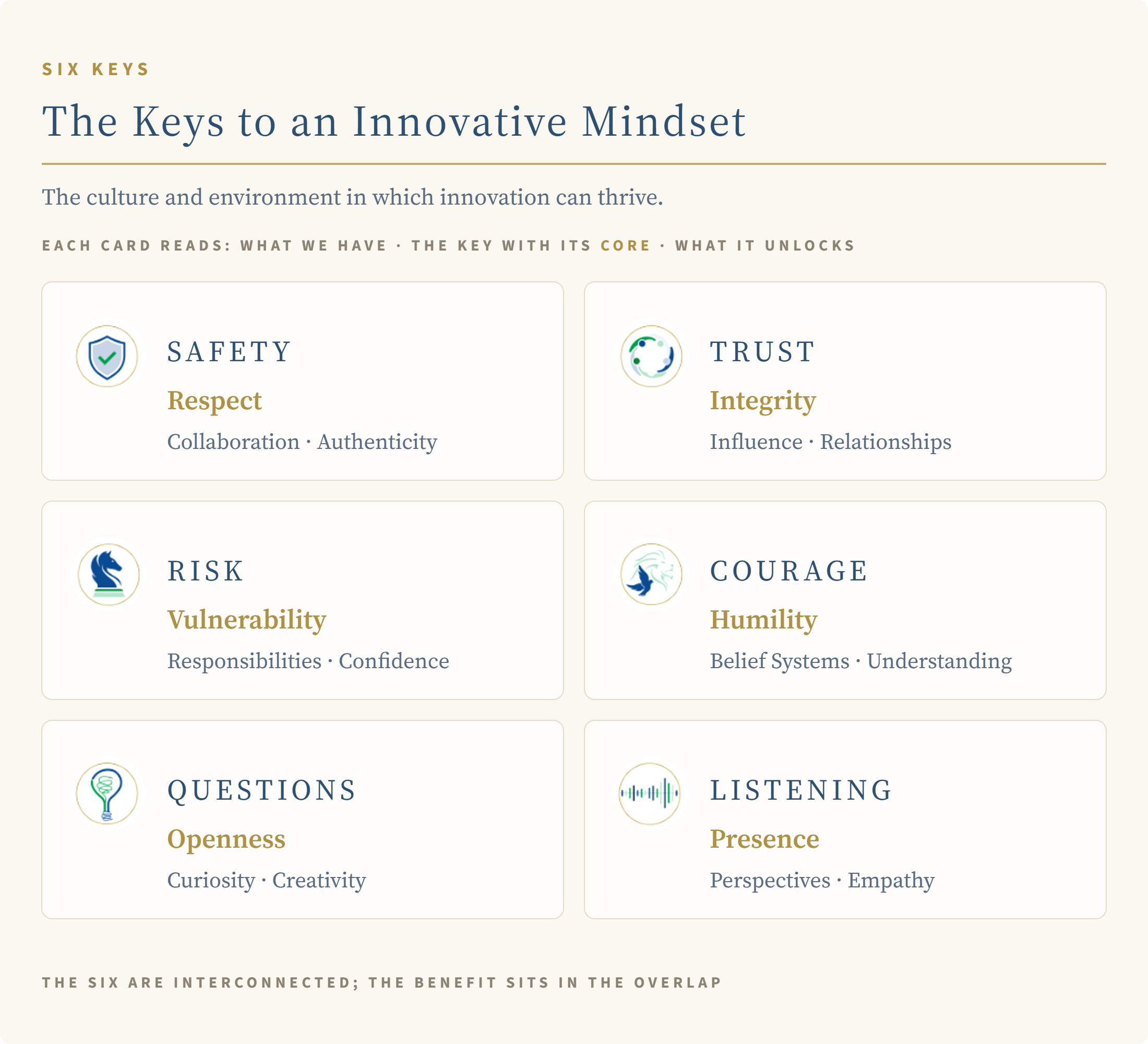
An innovative mindset is a way of thinking that opens possibilities and makes the most of the resources you already have. It combines curiosity, openness to new ideas, and creative problem solving with a clear view of the future.
A rigorous process cannot compensate for evidence that has been filtered before it enters the room. By the time information reaches most leaders, it has been softened on the way up. Ideas arrive pre-shrunk; risks arrive pre-excused. Part of the work is building the trust that gets you the unfiltered version.
The six keys are interconnected and work as one chain. Safety, trust and responsible risk taking make honest dialogue possible. Courage, questions and listening turn that dialogue into understanding. The full benefit sits in the overlap, where all six hold at the same time. It is learnable, buildable, and measurable, and it runs beneath every APHIONE engagement.
Why this matters now
AI is changing how decisions get made. Faster is not the problem. The problem is faster decisions built on knowledge that was never written down. Your systems keep a meticulous record of what was decided. The reasoning behind those decisions, the assumptions, the evidence, what customers said firsthand, lives in conversations, inboxes, and old decks, and it often leaves when people change roles.
The work writes that reasoning down: every phase produces a governed record of why, filed in your environment so the knowledge and AI systems you already run can use it. We are not selling AI. We make the reasoning behind your decisions explicit and usable, with human judgment accountable for the choice.

Start with the question you have
Tell us what your organization is weighing, and we will suggest where to begin.
See how we workInvest with clarity. Build what’s next.